Willow Island 1978: young concrete under construction loads
At Willow Island, the scaffold and formwork relied on the young concrete shell below them. The construction load could not be considered separately from the strength the concrete had reached that morning. That connection is the focus of the NBS investigation. [1]
At a little after ten in the morning on 27 April 1978, the top of a cooling tower under construction at Willow Island, West Virginia, collapsed. The tower had reached 166 feet (51 m). A four-level scaffold was anchored to the collapsing section of the shell, and it fell with it. All 51 workers on the scaffold were killed. [1] This was a failure during construction, not in service.
How the system worked
The shell was built with a patented lift-form method. A lift is one 5-foot (1.5 m) layer of concrete, and the normal routine was one lift a day, with exceptions at the bottom and top of the tower. At the time of the collapse, 28 lifts were done. Lift 28 had been placed the day before, and the formwork and scaffold, which were carried by the shell below them, had already been raised for lift 29. According to eyewitness accounts in the report, the collapse began when the third bucket of concrete was being hoisted to the working platform. [1]
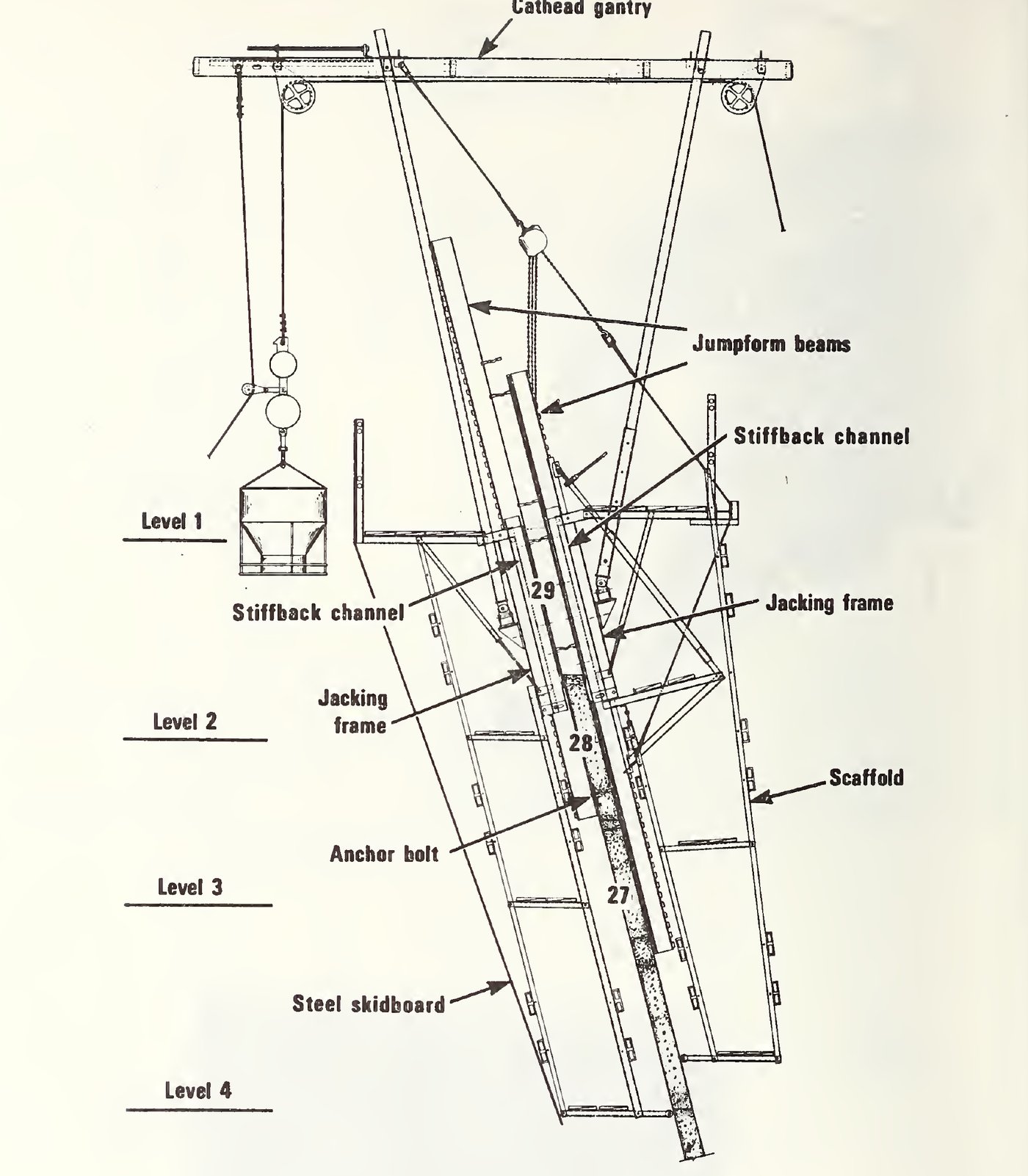
The National Bureau of Standards, working for the Occupational Safety and Health Administration (OSHA), used site inspections, OSHA case records, laboratory tests on concrete and components, and structural analysis. It concluded that the most probable cause was construction loads put on the shell before the concrete of lift 28 had gained enough strength to carry them. Its calculations showed stresses at several points in that area equal to or above the strength of the shell in compression, bending and shear. [1, pp. 71-72]
Reading it through PRISM
I use PRISM here to follow how the investigators tested possible explanations, then ask what evidence a reviewer would have needed before work continued. The latter is my retrospective reading. Problem Framing, Research, Interpretation and Synthesis organise the inquiry, with Metacognition checking assumptions throughout. Evidence found later can require an earlier question to be reopened. The case illustrates how I use the method; it does not validate it.
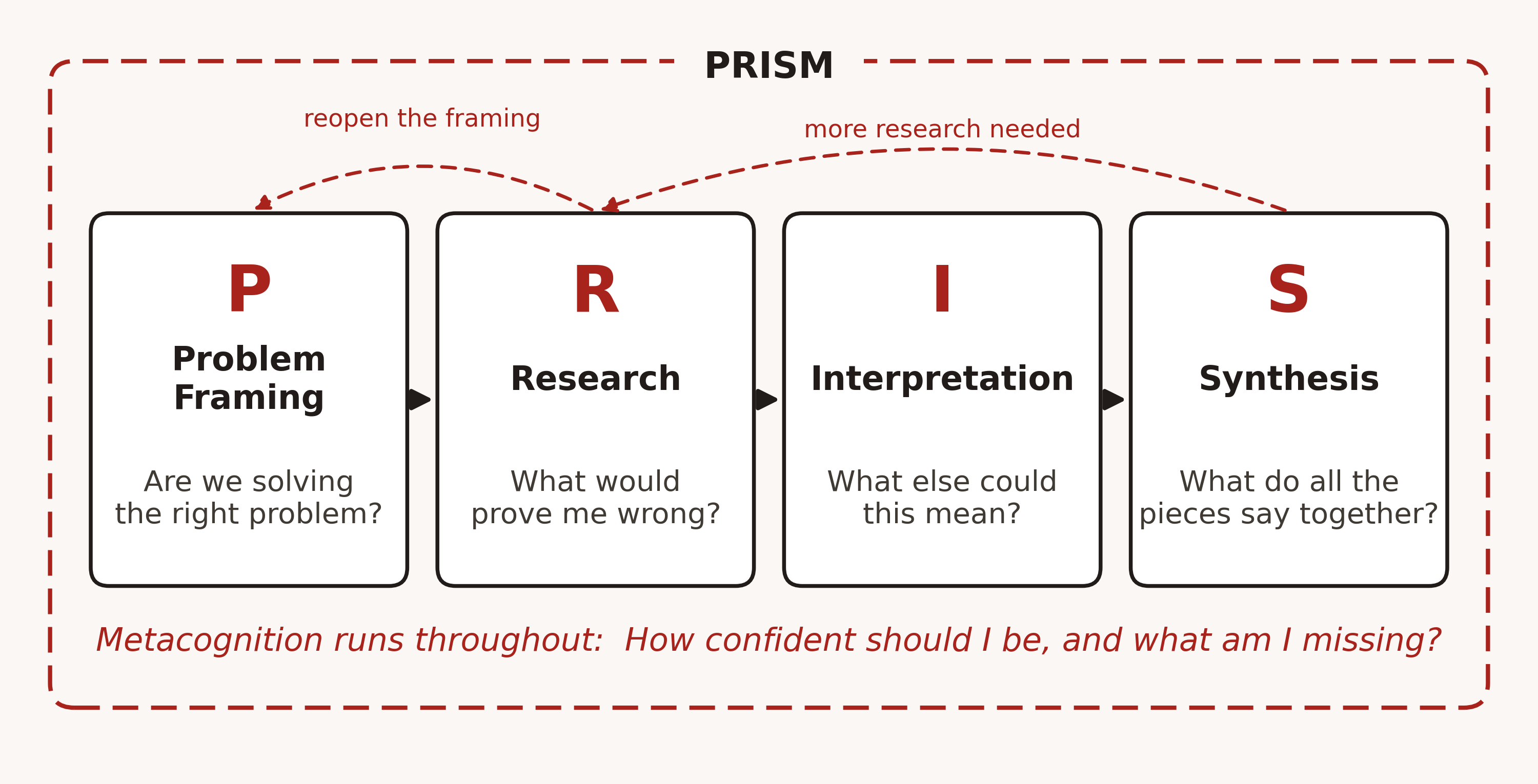
Problem framing: are we solving the right problem? I would want the decision to move the forms to depend on evidence that the concrete could support the construction loads. The NBS conclusion identifies inadequate strength under those loads as the most probable cause. [1, pp71-72]
Research: what would prove me wrong? The investigators examined and tested the parts that might have failed first, including the grip-hoist on the static line, the hoist cable and the anchor bolt assemblies. They concluded that failure of these parts hadn't started the collapse. Two hoist cables did break, but only after the debris had begun to fall. [1, pp. 33-37] That finding, together with the concrete tests and the analysis of the shell, supported their conclusion.
Interpretation: what else could this mean? The collapse came about 18 hours after lift 28 was completed. Concrete near cathead no. 4 had been placed earlier and was estimated to be about 20 hours old. [1, p21] Field-cured cylinders were tested at 24 and 25 hours, giving 283 and 299 psi. Those were not direct measurements of the shell at failure. The investigators interpolated from the setting time to the cylinder results, checked the estimate against a strength-maturity curve and used approximately 220 psi (1.52 MPa). They said conditions near the top of lift 28 could have reduced strength to about 200 psi (1.38 MPa). The ground-level cylinders did not reproduce every condition in the shell. [1, p65]
The laboratory specimens were a separate exercise. They were cured to follow local temperature. The chamber used records from an airport about five miles from the site, so these tests were a proxy and not a measurement of the tower. [1, p. 24]
The cement raised a second question. Samples obtained from the supplier after the event, by NBS and by OSHA, didn't meet the ASTM requirements for Type II cement, because their silicon dioxide content was below the minimum. Physical test results came from Law Engineering Testing Co. and the NBS Cement and Concrete Reference Laboratory; Law Engineering carried out the chemical analysis. The seven-day mortar strength was also below the ASTM value, and the two samples differed from each other in early strength. They aren't necessarily from the batch used in lift 28. The report says the difference in strength gain could be due to the slower early strength of the OSHA sample, and it used the data that best matched the lift 28 cylinders. That isn't the same as saying the cement alone caused the collapse. [1, pp. 21-22, 27]
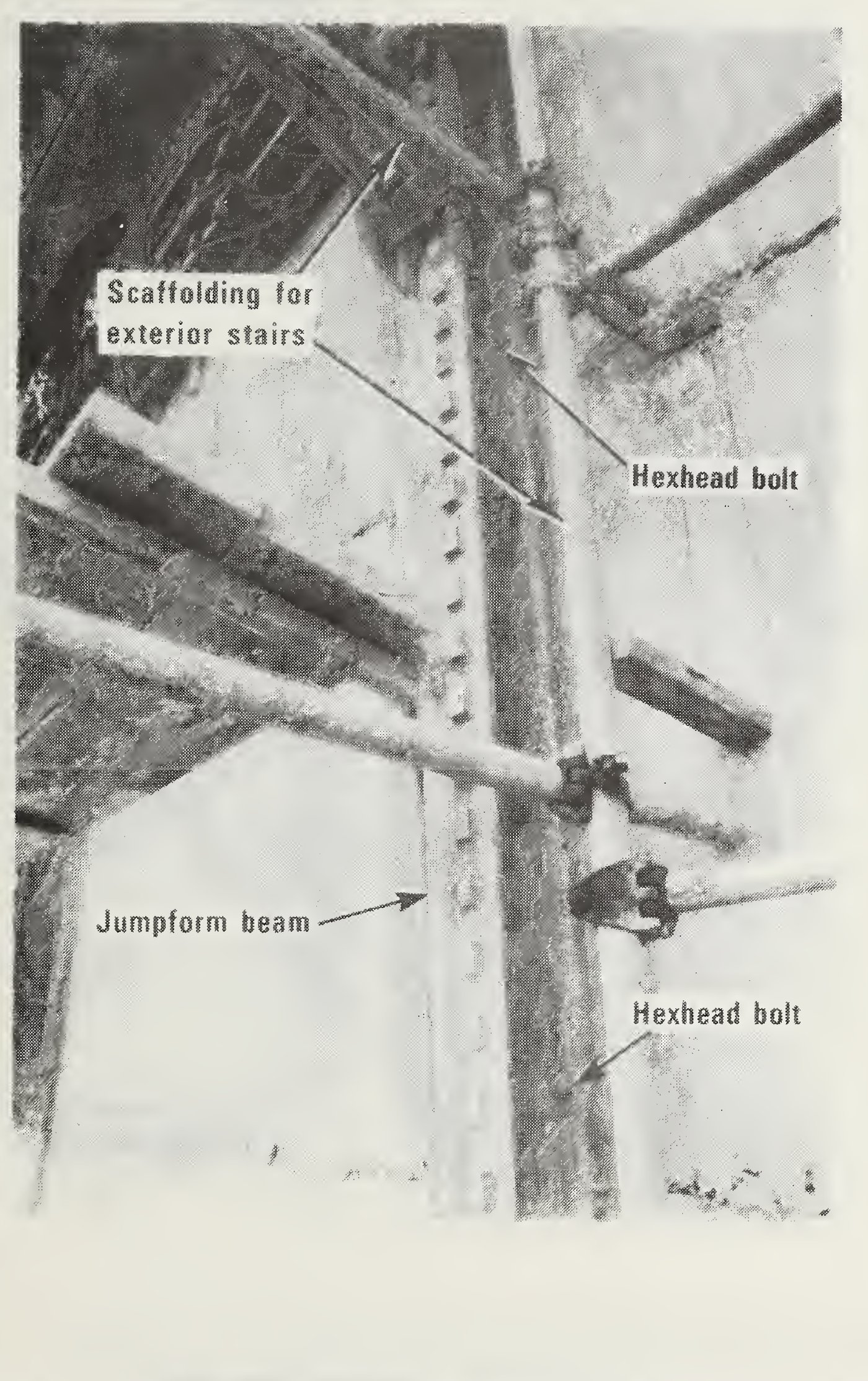
Synthesis: what do all the pieces say together? The top anchor bolts in lift 27 were still attached to the jumpform beams. Bottom bolts had been removed, and concrete around bottom bolt positions was crushed. Those observations concern lift 27. [1, pp13-14] The separate check on the bottom anchor bolts in lift 28 found a calculated force of about 16,000 lb against a capacity of about 40,000 lb; the investigators ruled out their failure as the trigger. [1, pp36-37] I would keep the observed damage and the analysis of initiation distinct.
Live loads, including workers and site equipment, formed a relatively small part of the total shell load in the analysis. [1, p48] A later NBS study examined the ground anchor for the static line. It concluded that lift 28 would probably not have failed had the anchor stayed in its earlier position. Its model also found that an additional lower line of bolts would not have prevented failure. These are modelled alternatives for this tower, not general rules for other systems. [3, pp18-19]
Metacognition: how confident should I be, and what am I missing? The NBS calls its conclusion the most probable cause. The strength at failure is an estimate, with uncertainty about how closely the tests represent the shell. [1, pp65,71-72] Eyewitness accounts also contribute to the account of initiation. [1, p1] I would not turn an estimated strength or a retrospective model into an exact reconstruction of every moment.
All 51 workers on the scaffold died. [1, p1] The finding connects the construction load to concrete that had not developed enough strength to carry it. [1, pp71-72]
The review question I take from it is what evidence supports loading the structure now, with the support arrangement actually in place.
I examine decisions like this in What Are We Missing? How to Think More Clearly Before You Decide. The book has fifteen chapters, including the Deepwater Horizon case, and sets out PRISM for decisions of our own.
Publication is planned for 13 February 2027. If you have a call coming that you can't afford to get wrong, sign up to hear when it's out at zafaralam.co.uk/#launch.

Zafar Alam is a civil engineer and Chartered Construction Manager with about 12 years on major projects. He is the author of What Are We Missing? How to Think More Clearly Before You Decide, planned for 13 February 2027.
Sources
[1] Investigation of Construction Failure of Reinforced Concrete Cooling Tower at Willow Island, West Virginia, NBSIR 78-1578, National Bureau of Standards, November 1979. https://nvlpubs.nist.gov/nistpubs/Legacy/IR/nbsir78-1578.pdf (printed pages: background p. 1; anchor bolt observations pp. 13-14; concrete age and tests pp. 20-27; component checks pp. 33-37; strength estimate p. 65; conclusions pp. 71-72)
[2] NIST publication record for NBS IR 78-1578 (published 30 November 1979). https://www.nist.gov/publications/investigation-construction-failure-reinforced-concrete-cooling-tower-willow-island-west
[3] Lew, H. S. and Fattal, S. G., Analysis of Construction Conditions Affecting the Structural Response of the Cooling Tower at Willow Island, West Virginia, NBSIR 80-2010, National Bureau of Standards, July 1980. https://nvlpubs.nist.gov/nistpubs/Legacy/IR/nbsir80-2010.pdf (section 6, pp. 18-19)