George 2024: the cracks reported before collapse
At George, I would ask what the partly completed building could safely support. The CBE investigation found that it collapsed under its own weight before completion. [1]
The building came down at 2:09 in the afternoon on 6 May 2024: five storeys above a basement, with parking at ground level and four floors of flats, still under construction at 75 Victoria Street in George, in South Africa's Western Cape, and nearing completion. The first emergency call followed at 2:14, five minutes after. The municipality's initial 6 May, 9pm notice reported 75 construction workers on site, a figure its 12 May, 3pm update later raised to an estimated 81, [4] and in the end sixty-two people were trapped, the rescue operation ran for 260 hours, [1] thirty-four people died [2] and twenty-eight were injured. [5] That is the Council for the Built Environment's stark finding: the building collapsed under its own weight before it was ever finished. [1]
What the building was
Picture the building: 42 flats over a basement, ground-level parking and four residential floors; reinforced concrete framing with load-bearing masonry up to first-floor level, then load-bearing masonry carrying reinforced concrete slabs above. [1] The investigations surfaced three strands (deficient ground information, concerns about the concrete supplied, questions over the structural designer's competence), and I keep them apart because some rest on documents and analysis while others rest on interviews. [1]
Three official processes sit behind this account, and their remits matter. The National Home Builders Registration Council (NHBRC) investigated its own processes; the Minister of Human Settlements reported the findings on 9 April 2025. [2] The Council for the Built Environment (CBE), an entity of the Department of Public Works and Infrastructure, put Dr Ron Watermeyer in charge of a multidisciplinary investigation, and his executive summary, dated July 2025, is titled "Anatomy of a failed system". [1] The Engineering Council of South Africa (ECSA) also investigated a registered person's conduct. [3][8] Minister Dean Macpherson, on 6 May 2026, urged the National Prosecuting Authority to make prosecutorial decisions following completion of the police investigation, which is a dated account of the criminal process rather than a statement of its present outcome. [6]
The warnings on the record
The CBE document records reports of visible distress before the collapse, though its opening account labels the evidence about the first failure anecdotal, so the cracks, patching and concrete-strength account below need that qualification. [1]
A subcontractor told investigators that cracks were visible as early as 2023, to the extent that you could see through them while standing in the basement; cracks around the base of a ground-floor column "resembled punch-through patterns", in the report's careful words, and concerns were also raised about the narrow supporting columns and the large spaces between them, and about the absence of critical features such as slab expansion joints. [1] As late as two days before the collapse, a contractor was observing unusual movements and vibrations in the roof slab. [1]
On the CBE document's account, the site manager had the cracks patched with sand, cement and mortar; whether an engineer also assessed the damage is something that account does not establish. [1]
A subcontractor told investigators that concrete supplied for the basement and first-floor slabs was 13 megapascals, against specifications of 19 or 25, the same figures the Minister repeated in July 2025. [1][5] The CBE account reports an interview and does not identify a cube-test result as the basis for the 13-megapascal figure, so I cannot use it to establish what every test on the project did or did not show.
The CBE found that the geotechnical investigation fell far short of the minimum requirements of the South African national standards. It says the supplied geotechnical report omitted trial pit locations, Dynamic Cone Penetrometer test results and geological maps. That is a finding about the report's contents, not proof that no physical tests took place. [1] Groundwater was discovered in the basement, and the investigation found that NHBRC inspectors had significantly misrepresented the condition of the water-logged site. [1]
The health and safety agent resigned during construction, saying continuous safety violations made it impossible to safeguard the client's and contractors' interests, a resignation the Minister said in July 2025 had not been reported to the relevant authorities. [1][5] The approved competent person for the structural system was a 76-year-old professional engineering technologist, registered since 1987, who provided the rational design, including the foundations. [1] The CBE document says he "seemingly lacked the necessary expertise for designing complex structures". It criticises reliance on self-assessed competence and argues for independently assessed structural credentials for higher-risk work. In that critique, the investigators argue that relying on the self-assessed competence of professionals registered in civil engineering is safe only for low- to medium-risk structural systems, giving buildings no more than two storeys high as an example. They call for assessed credentials for higher-risk work. [1, PDF p15, printed vii] The NHBRC did not request structural arrangement drawings before issuing an enrolment certificate on preliminary reports. [1]
The gates that signed themselves
The CBE report describes three administrative gates: approval before construction, notification at commencement, and close-out at completion. [1] The collapse occurred before the building reached completion. The earlier approvals and inspections therefore need examining for what they actually checked.
From the NHBRC's own investigation: the builder had never declared its intention to construct a multi-storey building, so the grading process meant to test its capability never ran; enrolment forms were processed on 11 July 2023 even though the scheduled construction start was 19 June; one official used another official's login credentials to enrol the first phase; the first inspection came eight working days after enrolment, against a five-day protocol; and inspection reports recorded units that had not yet been built. [2] The CBE records the building plans approved on 6 July 2023 and the municipality advised of the intention to commence on 3 July. [1] The NHBRC's finding is that work on site started before the approvals were finalised. [2]
The CBE report also records that an Auditor-General review of the municipality's building-control function covered these plans and produced no significant findings, and it then argues that the same structural system would still have collapsed had it been an office block, outside the NHBRC's residential processes; that counterfactual is the investigators' own. [1] The point they press is that an administrative approval, by itself, establishes nothing about structural adequacy: what they treat as essential is sound design, suitable materials and construction methods, together with the competence and integrity of the people doing the work. [1]
Reading it through PRISM
PRISM is my own method, and the five questions come from my book, What Are We Missing? How to Think More Clearly Before You Decide, where the method is set out in full. The sequence runs Problem Framing, Research, Interpretation and Synthesis, with Metacognition standing over the whole of it, checking assumptions and confidence; Research can reopen the framing, and gaps found in Synthesis can send us back to Research. Here I have applied it to the months on record, from the first reported cracks in 2023 to the afternoon the building fell, working from reports that record what was seen, tested and said but cannot establish what the people involved believed. The headings organise the account; what follows illustrates the method rather than testing it.
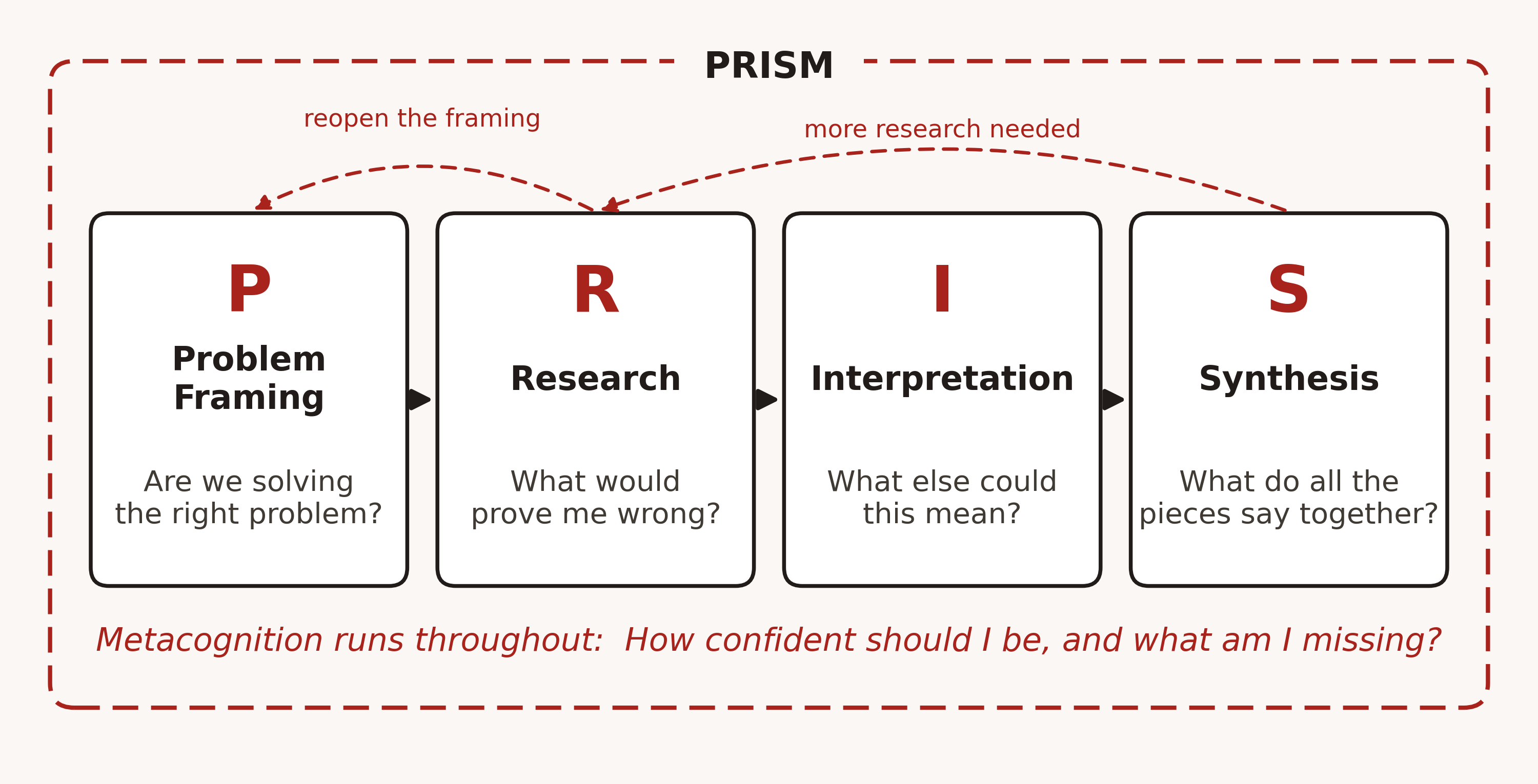
Problem framing: are we solving the right problem? In the account reported to investigators, cracks were patched with sand, cement and mortar. [1] I would want the decision to address their cause and the safety of continuing construction. The patching account alone cannot tell me which questions anyone asked or whether an assessment took place.
Research: what would prove me wrong? The CBE found that the geotechnical investigation fell short of the national standards' minimum requirements. It also found that the NHBRC had not requested structural arrangement drawings, which an experienced structural engineer might have queried. [1] On concrete strength, the discrepancy on record calls for test records, and the interview account does not supply them. [1] Separately, the NHBRC investigation found inspection reports referring to units that had not yet been built. [2] Specific gaps in evidence and oversight, then; not proof that every possible check was absent.
Interpretation: what else could this mean? On one hand the executive summary says the building collapsed "without warning"; on the other, the opening account records reports of cracks and of unusual slab movement. [1] That tension deserves to stay visible; I will not hand the word "warning" a special meaning the report never defines. The 13-megapascal account has a limit of its own: a subcontractor said it, and it establishes neither the reason for the alleged shortfall nor the results of every concrete test. [1]
Synthesis: what do all the pieces say together? Across the investigations the picture is of deficient ground information, reported concrete-strength problems, and weaknesses in both design scrutiny and inspections. [1][2] These findings concern different controls and carry different levels of evidence. Together they support the CBE's call for competence to be demonstrated for the structural risk involved and for checks to go beyond administrative compliance. [1] The Minister's April 2025 statement also described the new Housing Consumer Protection Act as part of the response. [2] I am not using that statement to assert the Act's commencement status today.
Metacognition: how confident should I be, and what am I missing? The CBE investigators say the NHBRC was the only institution to respond to their requests and did not share its forensic report. They therefore used selected media reports and press releases and drew inferences from the information available. [1] The opening account of cracks, patching and concrete strength is not a substitute for the underlying test records. ECSA's statement is dated 22 July 2025, not October: October appears in its upload address. It says charges had been brought against a registered person implicated in the collapse. ECSA's subsequent appeal statement confirms that the person appealed against the disciplinary tribunal's finding of improper conduct, and said the relevant tribunal decision or publication could not take effect before the appeal was decided. Its appeal statement does not give the filing date. [8] Neither statement establishes the outcome of every legal process, so I make no blanket claim that no court has ruled. The May 2026 ministerial statement is reported above on its own date. [6]
What to take from this
For me, the practical question is what evidence supports continuing work when a partly completed structure shows distress. The CBE recommends reporting structural distress and stopping work where warranted until it is established that continuing is safe. [1] That is a specific action, rather than reassurance from an approval document.
Closing
Thirty-four people died in the collapse. [1] The CBE document records reports of cracks as early as 2023 and unusual slab movement two days before the collapse. [1] Those reports deserve attention with their evidential limits intact.
I wrote What Are We Missing? How to Think More Clearly Before You Decide to examine decisions like these. Read about the book.

Zafar Alam is a civil engineer and Chartered Construction Manager with about 12 years on major projects. He is the author of What Are We Missing? How to Think More Clearly Before You Decide, planned for 13 February 2027.
Sources
[1] Investigation into the multi-storey building collapse in George on 6 May 2024: Anatomy of a failed system, executive summary, Council for the Built Environment, July 2025. https://pmg.org.za/files/250917George_Building_Collapse_Executive_Summary_July_2025.pdf
[2] Media statement by the Minister of Human Settlements, Thembi Simelane, on the NHBRC's final report into the George building collapse, 9 April 2025. dhs.gov.za media statement (PDF)
[3] Media statement, Ministry of Public Works and Infrastructure: Minister Macpherson releases findings of ECSA and CBE investigations, 19 July 2025. publicworks.gov.za media statement (PDF)
[4] Update on building collapse, Victoria Street, George, George Municipality, 6 May 2024, 9pm. https://www.george.gov.za/notices/update-on-building-collapse-victoria-street-george/ Later count: 12 May 2024, 3pm update, https://www.george.gov.za/media-statement-3pm-update-on-building-collapse-site-12-may-2024-1500/
[5] Minister Macpherson speaks on George building collapse, SAnews, 20 July 2025. https://www.sanews.gov.za/south-africa/minister-macpherson-speaks-george-building-collapse
[6] Minister Dean Macpherson urges National Prosecuting Authority action after SAPS probe into George building collapse, South African Government, 6 May 2026. gov.za media statement. Used for the Minister's statement on that date, not a current case-status determination.
[7] Housing Consumer Protection Act 25 of 2024. The discussion above uses the Minister's 9 April 2025 account in source[2]; no present commencement-status claim is made.
[8] ECSA prefers charges on registered person implicated in the George building collapse, media statement, 22 July 2025, p1. ECSA receives appeal from registered person implicated in George building collapse, official appeal statement. The latter does not state the filing date.