01 / Macondo, 2010
Deepwater Horizon
11 lives
The test readings were anomalous. What made experienced people read them as acceptable?
The case and its sources, chapter 1 ▾Planned for 13 February 2027

How to Think More Clearly Before You Decide
On 20 April 2010 a drilling crew read an anomalous test as acceptable. Eleven men died. Smart people. Good information. The wrong decision. What were they missing?
A way to ask, before the decision is made and cannot be called back, what you might be missing.
For managers, engineers and teams whose decisions other people live with.
By Zafar Alam - civil engineer and Chartered Construction Manager, about 12 years on major projects.

Until launch
One critical-thinking tip every week, plus launch updates. Nothing else.
Something went wrong - please try again in a moment.
Check your email for a confirmation link and tap it to join. Until you do, you are not on the list.
01 / Why does it matter?
Different industries. Different rooms. The same gap: the problem was never properly framed before the decision. The failures below are the evidence, and each opens a chapter of the book. All of them are in the public record.
The failure record
Sources: House 737 MAX report · Oil Spill Commission · SEC on Knight Capital · SEC finding, 16 October 2013 · US Chemical Safety Board · ILO on Rana Plaza · IAEA on Chornobyl · the book’s Sources register.
Four of the failures in this book, drawn at the same scale.
Sources: Boeing 737 MAX · Deepwater Horizon · Challenger · Columbia
Fifteen chapters examining real-world decisions, one question each
11 lives
The test readings were anomalous. What made experienced people read them as acceptable?
The case and its sources, chapter 1 ▾$639bn Lehman Brothers assets at 31 May 2008
A model seemed to work for decades, and the world changed beneath it.
The case and its sources, chapter 2 ▾$9bn valuation
Prestige met one question too few: did the device actually work?
The case and its sources, chapter 3 ▾126 million potentially served IRA content on Facebook (estimate)
In 2005 Nature compared Wikipedia with Britannica. Separately, Facebook estimated in 2017 that approximately 126 million people may have been served content from Internet Research Agency pages during 2015-2017.
The case and its sources, chapter 4 ▾7 lives
Engineers warned against launch in the cold. Then the room changed what counted as proof.
The case and its sources, chapter 5 ▾11 million cars
The cars knew when they were being tested, and performed accordingly.
The case and its sources, chapter 6 ▾$125 million
The knowledge needed to prevent the loss existed on both sides of the country. It never travelled between two buildings.
The case and its sources, chapter 7 ▾7 crew lost on Columbia. Three came home from Apollo 13.
One room supported open reporting and brought three men home. The other let a warning soften as it travelled upward.
The case and its sources, chapter 8 ▾3 companies held pieces of the warning
The knowledge was on the rig. It stayed in pieces.
The case and its sources, chapter 9 ▾2014 a new chief executive
Could a whole organisation be asked to rehearse better thinking until it became ordinary?
The case and its sources, chapter 10 ▾207.6 seconds
Not a checklist executed and not a guess: every operation the book has named, running at the speed the situation demanded.
The case and its sources, chapter 11 ▾8.45 p.m. Eastern
A telephone conference. A room that would not hear its own engineers.
The case and its sources, chapter 12 ▾3 months old at her first seizure
Two coherent systems met in one hospital. Thinking harder could not mend what only thinking differently could.
The case and its sources, chapter 13 ▾5.7 points fewer false positives
The machine outperformed six radiologists. The more instructive story is what happened next, to the people.
The case and its sources, chapter 14 ▾1492
The slow tool teaches what the fast tool skips.
The case and its sources, chapter 15 ▾Swipe for all fifteen chapters
The information was there. The question wasn't. This book is about that question.
And in everyday life
Big failures get commissions and transcripts. Most gaps in thinking are quieter - a headline, a price tag, a room in agreement.
Shared widely. Nobody read past it.
A week comparing prices. Not a minute asking whether we needed it.
Everyone agreed. Nobody asked why.
These three are free to download and post, in the book's design - in Downloads ▾
The premise
In these cases the facts were available, and a person, a team or an institution still could not see what those facts meant together. So we need a way to ask the missing question. The question before the answer.
Read how it starts, or try the method on your own decision.
Read the free sample Run a decision through PRISM02 / Why this book?
The gap
The shelf this book sits on is not empty: fine accounts of how the mind errs, catalogues of biases, gripping autopsies of decisions that went wrong.
What is missing from that shelf is a working discipline - something you can run before the decision, in the meeting, at your desk, in the small hours when the answer looks obvious.
What this is
One framework, not a hundred effects.
Five moves for the minutes before a decision, each made trainable - and built for the world you decide in now, where a machine will draft your analysis and sound sure of itself while it does.
Why believe it
The record, not anecdote, carries the cases: official commissions, hearing transcripts and peer-reviewed research.
Every chapter's sources are listed in full, free to check. The Sources, free ↓
03 / Who is it for?
A manager before the hire
You are about to sign off a hire, a budget or a plan that other people will have to live with.
A founder before the signature
The numbers look good and the room is nodding. This is the minute before you commit.
A doctor before the diagnosis
The first diagnosis fits. This is the minute before you stop looking.
A parent before the answer
A child asks something hard and you already have an answer. This is the minute before you give it.
And everyone whose decisions others live with
When someone else pays for a wrong call, the minute before matters most.
04 / Who is behind it?
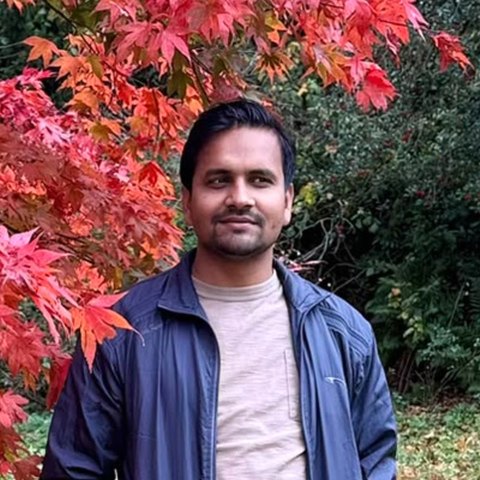
Zafar Alam, civil engineer and Chartered Construction Manager (MCIOB). About 12 years on major projects, five years writing this book. Full bio ↓
05 / How does it work?
PRISM is a five-move check you run before a decision hardens - at your desk, in a meeting, alone. It exists because smart people with good information still miss the question. Four moves in sequence, one watching over them all; what you take away is a decision you can defend out loud. Select a letter to look closer.
P / 01
Are we solving the right problem?
In plain words: saying what is actually being decided, before any solution gets a hearing.
When solutions arrive before the problem is agreed, the answer may be precise and still be wrong.
In the record - Volkswagen: the problem on the table was "pass the test", not "build a clean car".
What you'll be able to do: say the real decision out loud in one sentence.
PRISM is a synthesis of tested parts, not a separately validated model. Explore the framework in full in the book.
One case, all five moves
The room was asked the wrong question: "can you prove it will fail?" The standing engineering question had always been the other way round: "can you show it is safe to fly?"
The O-ring risk was in the record for years. The people holding the uncomfortable evidence argued against launching in the cold, the night before.
The burden of proof flipped: instead of the hardware proving itself safe, the engineers were asked to prove it would fail - in conditions never flown before.
Cold temperatures, a known erosion problem, a schedule under pressure. Each piece got a local explanation; nobody laid them on one table.
Confidence outran the evidence and nobody checked the process. Seventy-three seconds after launch, seven people were lost. The Rogers Commission found the risk had been known for years.
Chapter 12 tells the launch decision in full - the book ▾
The five moves on one page: the PRISM checklist ↓. The five moves on one case: the PRISM one-pager
Run the five moves on a decision of yours: the PRISM decision audit. Nineteen questions from the book, each with a check you can use: Questions, answered.
The whole book on one page - PRISM and all 15 chapters ↗
The method, in your hands
Take a decision sitting on your desk right now. Run it through PRISM - one question per move. Be honest; it is for your own thinking.
Try it now
Type a decision sitting on your desk, then walk it through all five moves in your own words. At the end, your decision and answers are sent to an AI model, which reads them back to you move by move. This site does not save them. The moves themselves are explained in the method.
The decision
One sentence is enough. PRISM will walk it through its five moves with you, one move at a time.
P / 01 - Problem framing
R / 02 - Research
I / 03 - Interpretation
S / 04 - Synthesis
M / 05 - Metacognition
Your PRISM run
Working through your decision
Taking it through the five moves, with Metacognition watching over all of them.
Written by an AI from your answers, using the book’s PRISM method.
Who you become
A difficulty arrives looking like a wall, solid and total. The wall stands because nobody asks what it is built from. This book trains the question until it is a habit.
Frames a problem well
Reads the evidence honestly
Catches itself being wrong
Understanding a failure is not enough on its own - so every chapter closes in protocols, small deliberate practices you run this week.
06 / What is inside?
What Are We Missing? How to Think More Clearly Before You Decide.
This is not self-help. It is a working discipline - a route you run, cases you can check, practice you keep.
Before you decide to read - the preface, in brief
Where the question came from is a story told in The author.
The book opens on Deepwater Horizon (the first case). It does not treat that as a failure of intelligence. It asks how the evidence was read, how a room handled doubt, and how to make the missing question easier to ask in time.
The promise is a discipline, not certainty. PRISM is a working route through the problem, the evidence, the interpretation and the decision, with a check on your own confidence throughout. You read it once; you run it for the rest of your working life.
It was written for the world you actually decide in now. A machine will draft your analysis, summarise your evidence and sound confident doing it. The oldest problem in judgement has met its newest amplifier, and this book was built with that amplifier already in the room.
Inside the book
Each card opens into the chapter's own bibliography: pick a chapter, see the works behind it. Chapter titles are from the current typeset edition.
Numbered endnotes
Notes as printed in each chapter’s Notes and Sources list: 586 numbered chapter endnotes, none in A Note on Method.
What your own machinery does before anyone else is involved.
The case · 01 / Macondo, 2010
11 lives
The test readings were anomalous. What made experienced people read them as acceptable?
PRISM move: Interpretation. "Low injury rate" became "safe rig", against the pressure data.
On 20 April 2010 the Macondo well blew out, killing 11. The national Commission found the failures systemic - management decisions that saved time and money while raising risk.
The case · 02 / The crisis, 2008
$639bn Lehman Brothers assets at 31 May 2008
A model seemed to work for decades, and the world changed beneath it.
PRISM move: Metacognition. Checking your own confidence: Alan Greenspan told a 2008 hearing he had found "a flaw in the model" - after it failed.
Lehman Brothers filed for bankruptcy on 15 September 2008, after 158 years in business. The official US inquiry concluded the crisis was avoidable. The book asks what a strong mind overlooks when its assumptions go untested. Asset figure: bankruptcy petition, Exhibit A, filed 15 September 2008.
The case · 03 / Silicon Valley, 2014
$9bn valuation
Prestige met one question too few: did the device actually work?
PRISM move: Research. A board of famous names stood in for evidence - the halo effect, where prestige is mistaken for proof. The disconfirming test was never demanded.
Fortune reported a valuation above nine billion dollars in 2014. The New York Times noted that, with one possible exception, the board lacked anyone with expertise in medical testing. By 2018 the company was gone.
The case · 04 / Information, 2005-2019
126 million potentially served IRA content on Facebook (estimate)
Nature compared 42 pairs of science articles in 2005; Wikipedia averaged around four inaccuracies an entry, Britannica around three. Separately, Facebook estimated in 2017 that approximately 126 million people may have been served content from Internet Research Agency pages during 2015-2017. Source: Facebook testimony, 31 October 2017.
The case · 05 / The launch, 1986
7 lives
Engineers warned against launch in the cold. Then the room changed what counted as proof.
PRISM move: Synthesis. The divergent data, the O-ring erosion, was filtered out to force one conclusion - agreement over the premise.
On the evening of 27 January 1986 engineers at Morton Thiokol argued against launching in a forecast 18 degrees Fahrenheit. They were overruled. Seventy-three seconds after launch the next morning, the shuttle was gone.
The case · 06 / The test, 2015
11 million cars
The cars knew when they were being tested, and performed accordingly.
PRISM move: Problem Framing. The problem on the table was "pass the test" - not "build a clean car". What a room chooses to value decides what it will see.
An on-road test by West Virginia University found a Jetta emitting up to thirty-five times the legal limit of nitrogen oxides. On 18 September 2015 the US Environmental Protection Agency issued a Notice of Violation; Volkswagen admitted the software was in around eleven million vehicles.
The case · 07 / The units, 1999
$125 million
On 23 September 1999 the spacecraft fired its engine to enter orbit around Mars and was lost. Ground software delivered thruster figures in pound-seconds; the navigation team expected newton-seconds, a factor of 4.45.
What happens to a decision once other people are in it.
The case · 08 / Two rooms
7 crew lost on Columbia. Three came home from Apollo 13.
Apollo 13's flight controllers worked the problem in the open, and the crew came home on 17 April 1970. After foam struck Columbia's wing in January 2003, engineers' requests for images moved upward and were declined. Columbia broke apart on 1 February 2003; seven people died.
The case · 09 / Macondo, 2010
3 companies held pieces of the warning
Warning signs had surfaced for months, in fragments, on the rig and in the offices of three companies. The presidential commission's chief counsel listed "ineffective communication and siloing of information" among the management failures.
The case · 10 / Microsoft, 2014
2014 a new chief executive
Satya Nadella, chief executive from February 2014, set out to change how people thought before changing what they shipped. The chapter notes that the story reaches us mostly through the company's own accounts, and prices the evidence accordingly.
The case · 11 / Flight 1549, 2009
207.6 seconds
At 3.27 p.m. on 15 January 2009 US Airways Flight 1549 met a flock of Canada geese. From the word "birds" to "we're gonna brace" the cockpit recording spans 207.6 seconds. All 155 people survived. The NTSB credited the crew's judgement and resource management, together with fortunate equipment and rescue conditions.
The case · 12 / Utah, 1986
8.45 p.m. Eastern
On 27 January 1986 Morton Thiokol's engineers in Utah tried to stop a launch in Florida. The chapter reads that night as a narrative autopsy, then lays five cases side by side - Challenger, Columbia, the Boeing 737 MAX, Deepwater Horizon and Carillion.
Deciding well when a machine can draft the answer for free.
The case · 13 / Merced, 1980s
3 months old at her first seizure
At three months old Lia Lee, the daughter of Hmong refugees, had her first seizure. To the paediatrician it was a medical emergency. To her parents it was a spiritual event, qaug dab peg, "the spirit catches you and you fall down".
The case · 14 / Radiology, 2020
5.7 points fewer false positives
On 1 January 2020 Nature published a Google Health study of screening mammograms. In the US data the AI cut false positives by 5.7 percentage points. One cancer was caught by all six radiologists and missed by the AI; another was missed by all six and caught by it.
The case · 15 / Sponheim, 1492
1492
Johannes Trithemius, abbot of Sponheim, wrote In Praise of Scribes to defend hand-copying against Gutenberg's presses. The chapter reads his first argument as this book's own, five centuries early, and does not claim more for him than he said.
Check the sources
Open any chapter above to see the works behind it, marked chapter by chapter. Or take the Sources PDF first - the endnote counts are in the counter above the chapters.
The Sources (PDF, free) ↓Selected chapters
Deepwater Horizon taken apart step by step, plus the PRISM framework and a self-diagnostic table.
The five mental operations behind a decision, opening with Greenspan's 'flaw in the model' testimony.
Theranos and FTX as cases of cognitive bias, with six protocols built to interrupt them.
How to check evidence before you trust it, with a verification checklist and a guide to reading numbers.
The night before the Challenger launch, and how to match a method to the problem.
Volkswagen's emissions case, and how to weigh evidence and price your confidence.
The Mars Climate Orbiter unit mix-up and four levels of not learning.
Apollo 13 against a later failure, and what psychological safety means for speaking up.
How Deepwater Horizon's warnings stayed in pieces, and four things a team can do on Monday.
The 2020 Nature mammography study, AI sycophancy, and PRISM applied to machine-made answers.
How to get it
Available to pre-order now: https://amzn.eu/d/0au4rUW3
The book is in review now. I am reading it the way it asks you to read everything: slowly, checking each claim, and sharpening whatever does not hold. The Kindle edition is available to pre-order now - planned for 13 February 2027, with print to follow. The price: as low as I can make it. This book was never meant to make money. It is what I want to leave my sons, and I want it within reach of anyone who wants to read it. Leave your email and you will hear the moment it is ready.

Find it at
What Are We Missing? is listed on the Motivated Savages indie author bookstore shelf. Release is planned for 13 February 2027.
07 / Can I read a sample?
Free to download, free to share.
Read
PDFThe free sampleThe cover, the preface and the first page of Chapter 1. 7 pages, free.↓PDFWhat this book solvesA two-page note from the author: the problem, the method, the record, and a one-page map of what the book does.↓PDFCognitive offloadingWhen the machine thinks for you - a one-page note from the author.↓Check the sources
PDFThe SourcesChapter bibliographies and claim-level source notes, grouped by type, with the chapters that cite each one. 68 pages, free.↓Explore
MapDeepwater Horizon: the case study mapThe rig, the night of 20 April 2010 hour by hour, the eleven men lost, and what followed.→The cards are words from the book in its own design - download and post them on your own channels; that is what they are for.
A look inside
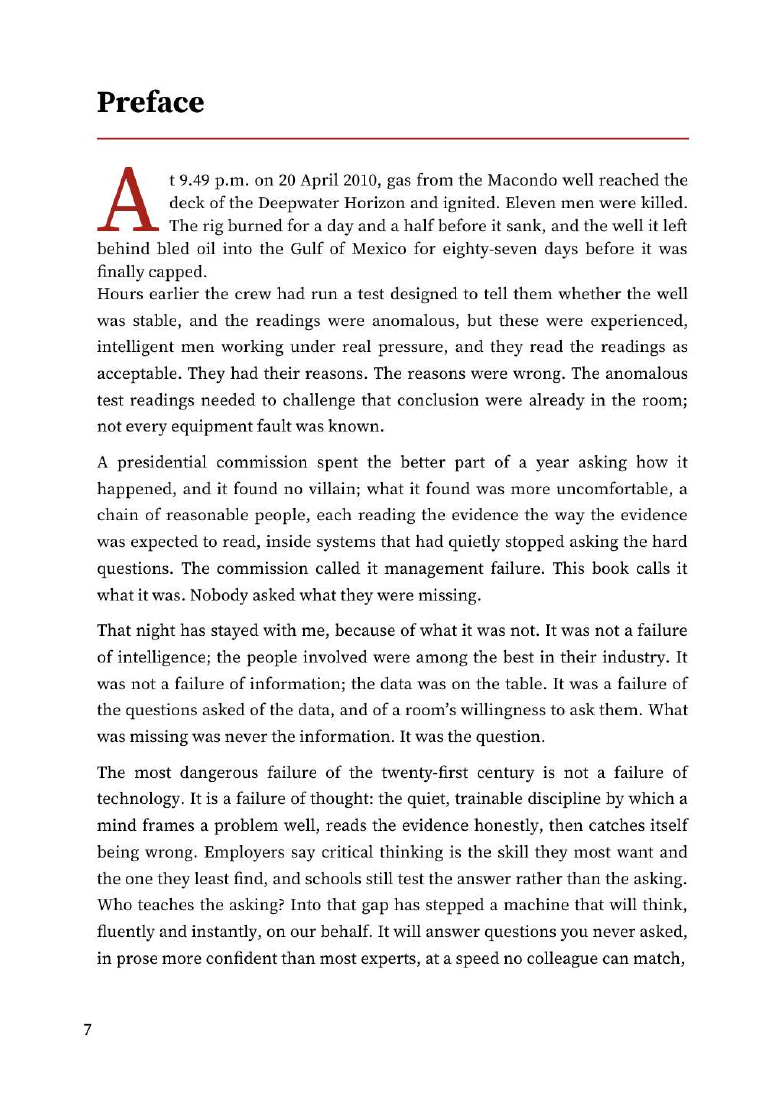
The most dangerous failure of the twenty-first century is not a failure of technology. It is a failure of thought: the quiet, trainable discipline by which a mind frames a problem well, reads the evidence honestly, then catches itself being wrong. Employers say critical thinking is the skill they most want and the one they least find, and schools still test the answer rather than the asking. Who teaches the asking? Into that gap has stepped a machine that will think, fluently and instantly, on our behalf. It will answer questions you never asked, in prose more confident than most experts, at a speed no colleague can match, and it will not once ask what the answer is missing. The oldest problem in judgment has met its newest amplifier.From the preface. The page shown is where it opens.Read the free sample
08 / Want to review it?
An advance review copy of the book, sent to you by email.
Read it, judge it on its merits and say so plainly. Send your feedback by the end of January 2027. Applying takes about two minutes, and every application is read by the author.
I approve review-copy requests one at a time. Each approved copy is stamped with the reviewer's name.
Nothing you send appears anywhere without your consent.
09 / Who wrote it?
I'm a Chartered Construction Manager (MCIOB) with a Masters in Construction Management. For about 12 years I've delivered major infrastructure and energy projects - first in the Middle East, then in the UK. On major projects I manage subcontractors and the decisions are mine; hundreds of people live with them.
Why does a construction manager write a book about thinking? Because I began this one after years on sites watching capable people with good information still fail to decide - not for lack of intelligence or data, but because the question that mattered never got asked in time. The book is my answer: five years of reading and testing, turned into a method you can run in the minutes before a decision. It is my second book.
For review enquiries, email [email protected].
Email enquiries ↗LinkedIn ↗ORCID ↗Already published

A fully rewritten new edition about human judgement and AI, for parents first. Second edition, October 2026. ISBN 979-8161264164.
View on Amazon ↗A reader of my earlier book, on Amazon
“We always hear about AI taking jobs but Zafar Alam’s journal is the first thing I’ve seen that actually talks about it taking over our minds… he shows with some really solid research how we’re losing that raw thinking power just by offloading the small stuff to apps.”
Sagar Poojary · 5 out of 5 stars · Verified Purchase
Amazon India, 19 January 2026 · reviewing The Cognitive Crisis in AI-Augmented Work (Kindle Edition)
Watch

10 / Reviews and updates
Where this book has gone for independent review, and exactly what has come back. A name below means the book was sent or handed over - never that the person endorses it. What comes back will be quoted exactly as sent, with the reviewer's name.
Review copies are out. Advance copies are with named reviewers and domain experts, handed over in person or sent directly.
Named reviewers, their roles and where each one stands are on the review page.
Dated updates
Published by others
8 October 2026 / Countercurrents
Countercurrents has published my column, “A climate promise is not a flood defence.” Read it there ↗ Author page ↗
My writing channels
October 2026 / Substack
Five columns on Substack: The change nobody rechecked; A forecast with no number is only a mood; A lesson is not learned because we wrote it down; Nobody writes alone; When one gauge disagrees.
9 October 2026 / Bear Blog
The change nobody rechecked, on my Bear Blog. Read it there ↗
October 2026 / Social
New columns and shorts between books: Substack ↗ Bear Blog ↗ X ↗ Instagram ↗ YouTube ↗
Press releases
10 October 2026 / SubmitPR
Press release: the second edition of The Cognitive Crisis in AI-Augmented Work is out now. Read it there ↗
10 October 2026 / SubmitPR
Press release: What Are We Missing? How to Think More Clearly Before You Decide is due on 13 February 2027. Read it there ↗
Other updates
Catalogues and profiles
Listed in reader catalogues and profiles - see the full record.
Announcements
Where the books are listed
3 October 2026 / BookLab by Bjorn
BookLab by Bjorn, a YouTube book channel, replied: “It’s a good fit for the list, and we’ll consider it when it comes out in February.” That is consideration for their February new-releases coverage, not a commitment to review it.
9 October 2026 / Second edition
My previous book is out in a new second edition. Available now in paperback and on Kindle - details with the author ↑
11 / Questions
Everything a reader asks before picking up this book. Missing something? Email [email protected].
What happens in the gap between evidence and judgement - and how to ask the missing question in time.
Anyone whose work ends in a decision - managers, engineers, doctors, founders, students, teams. If a machine now drafts your analysis and summarises your evidence, it was written with you already in the room.
The framework the book teaches: five moves, run before any decision. See it in full ↑ or run a decision through it ↑.
Many books explain how thinking errs. This one gives you a single route you can actually run, cases from the public record instead of anecdotes, and protocols - small deliberate practices - at the end of every chapter, because understanding a failure is not enough on its own.
No. The opening case is an oil rig, not an affirmation.
No, and no honest book can. It gives you a method to run before you decide. The promise in the book’s own words ↑
Yes. The free sample has the cover, the preface and the first page of Chapter 1. It is in Downloads ▾, and on its own page.
The current typeset edition runs to fifteen chapters and 458 pages. It has about 118,000 words of main text, not counting the endnotes and reference lists. At about 250 words per minute, that is about 8 hours of reading. The final print page count depends on the format, which is still to be announced.
Yes. Nothing here assumes training: the machinery of thinking is explained in plain words, and every chapter's sources are listed for you to check. The only requirement is a decision you care about.
Because, as the preface puts it, "the most dangerous failure of the twenty-first century is not a failure of technology. It is a failure of thought: the quiet, trainable discipline by which a mind frames a problem well, reads the evidence honestly, then catches itself being wrong." What the book gives you is in The book; you can try its method on your own decision right now.
Three circles: the mind, the room, the machine. The chapter list ↑
Five things, one for each PRISM move. See the five moves ↑
All of them - drawn from the public record: official commissions, hearing transcripts, court records, journalism and company accounts. The cases ↑ · the sources ↑
Every chapter's bibliography is open to read, and the counts of works and endnotes sit above them. Explore the chapter bibliographies behind the book ↑
It is a synthesis of tested parts, not a separately validated model - and the book says so openly. The parts come from published research; the route through them is his.
A machine will now draft your analysis and sound sure of itself while it does - which makes the oldest problem in judgement more expensive, not less. The book was written for exactly that world: see The book ↑
Civil engineer and Chartered Construction Manager. The full bio is in the author section the full bio ↑
He tells that story himself in The author ↑
Yes - The Cognitive Crisis in AI-Augmented Work, second edition published October 2026. Details and its reader reviews ↑
Planned for 13 February 2027. Available to pre-order now: https://amzn.eu/d/0au4rUW3 - the facts ↑
The Kindle edition is available to pre-order now - planned for 13 February 2027, print to follow. The intention is to price it as low as possible, so more people can afford it - the aim is awareness, not profit.
AI assisted with gathering, testing arguments, facts and writing. The author checked the work; the reading, judgement and decisions stayed his.
Follow the author on Instagram (@whatrwemissing) or the book on X (@WhatAreWMissing), or check the news below - it only carries dated, verifiable updates.
The downloads section has free quote cards, in the book's own design, made for posting on your own channels. That is what they are for.
Email [email protected]. Endorsements are published with the reviewer's consent, exactly as sent.
Deliberately so. Five of the fifteen chapters, 8 to 12, are about the room itself - why a table of smart people can sign off on a wrong call, and what decides whether doubt gets spoken out loud.
Kahneman's book is the landmark account of why the mind errs - the two systems, the biases, the decades of evidence. What Are We Missing? is about what to do in the minutes before your own decision hardens. One route to run rather than a catalogue to admire - and the room and the machine are in it too.
Rolf Dobelli's book is a field guide: ninety-nine short chapters, one thinking error each. This book is the opposite shape - a single framework, PRISM, that you run before any decision, with protocols at the end of every chapter that turn the moves into habit.
Noise, by Kahneman, Sibony and Sunstein, is about unwanted variability - why the same question gets different answers from different judges - and its remedy, decision hygiene, is aimed mainly at organisations. What Are We Missing? works one step earlier: whether the question being answered is the right one at all, for a person, a room, or a machine.
Tetlock and Gardner studied people who are measurably best at predicting events: they update often, think in probabilities, keep score. This book is about the decisions that never get scored - the ones you make once and cannot take back. Same family, different room.
Read Kahneman to understand the mind. Read this when the decision is yours and the room has gone quiet. It was built for the world you actually decide in now - with AI already in it.
Review copies are out. Launch is planned.
The launch
One critical-thinking tip every week, plus launch updates. Nothing else.
Something went wrong - please try again in a moment.
Check your email for a confirmation link and tap it to join. Until you do, you are not on the list.
Watch one short
Articles
17 October 2026
Zafar Alam examines the 1992 Chicago freight-tunnel flood and the repair proposal recorded in the chief bridge inspector's memo.
17 October 2026
Zafar Alam examines the Hyatt Regency walkway load path, review stamps and the capacity findings in the NBS investigation.
17 October 2026
Zafar Alam examines Sherman Kent's account of ambiguous probability words and the limits of putting numbers on uncertainty.
Start with the five PRISM questions above. If a repeatable practice, source-checkable cases and a clear account of AI's role matter to you, follow the book to launch.
Follow the book ↗Ask about the bookAnswers come from the book's own material, worked out fresh each time. Nothing you type is kept - unless you leave the author a note, which is stored with your email so he can reply.
Rather hear from the author himself? Leave him a note →
Your note goes straight to Zafar. He replies by email, usually within a few days.
← Back to the chat


